
Showing posts with label Tate Britain. Show all posts
Showing posts with label Tate Britain. Show all posts
20 May 2013
'A Walk Through British Art' - Tate Britain's new Interpretation model
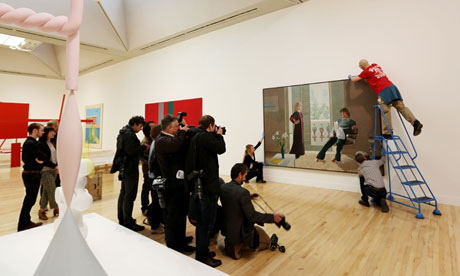
Instigated by Tate Britain's director Penelope Curtis, the permanent collection has been re-staged. The new display model ‘A Walk Through British Art’ went public on the 14th May 2013, reversing most of the decisions made when Tate Britain first opened. Factors of Curtis’ rethink include: the removal of accompanying interpretation, chronological display in place of thematic, and lastly the inclusion of more artworks. However, with the introduction of this new model comes the question – why?
Museum Interpretation largely contributes to how exhibits are percieved and experienced by the visiting audience; therefore a big question for these institutes has always been: how much interpretation should we provide, and in what form? Each of the changes implemented by Curtis alter the way in which this narrative is delivered. Instead of attaining context through the artworks’ accompanying text panels, this now takes place in the form of ‘Introduction rooms’ (Sabine Kohler, Tate, 2013); separating the text display from the artwork display. Also providing context is the new chronological order of the permanent collection. Different to Tate Britain’s old thematic model, the chronological display links art to its history more directly; allowing artworks to describe British history, and British history to help describe the artworks. Additional to the chronological timeline running along the walls, the central floor space is filled with the BP spotlight collection 'offering more depth on particular artworks, artists or themes' (M+H Magazine, 2013) which will be the only part of the display that regularly changes.
Assuming that Tate Britain removed text panels in favor of an ‘un-disturbed’ experience, my first reaction to the Guardians headline: ‘Tate Britain scraps explanatory panels next to works of art’ was - oh no, the audience will be alienated! However, instead it seems that this model is about re-deciding when museum interpretation should be introduced, minimising unnecessary intervention. Removing the option for visitors to read their way around the Tate Britain, this new model ensures that the primary activity carried out in the galleries is to engage with art by ‘looking’.
3 Feb 2009
Bourriaud as curator of Tate Britain Triennial
Jonathan Jones has written an interesting piece about Altermodern (defined as post-post-modernism) at Tate Britain, a triennial of British art curated by Bourriaud. It will be interesting to see how far the exhibition is able to avoid the illustration of theory, as many of the selected artists cite Relational Aesthetics as a fundamental influence upon the nature of their practice. The concept of heterogeneity might dominate both theory and practice (if they are to be considered separate) to such an extent that it appears homogeneous. There is also the idea of the star guest curator, which is also discussed in this month's Museums Journal.
Here's the link for the article:
http://www.guardian.co.uk/culture/2009/feb/03/tate-britain-triennial
Here's the link for the article:
http://www.guardian.co.uk/culture/2009/feb/03/tate-britain-triennial
Subscribe to:
Posts (Atom)